Overview
Adama Science and Technology University (ASTU) was originally established in 1993 as Nazareth Technical College (NTC), offering bachelor’s and diploma-level education in technical fields. The institution later evolved into Nazareth College of Technical Teacher Education (NCTTE). In 2006, it was inaugurated as Adama University (AU), which expanded its academic offerings to include faculties in Natural Sciences and Humanities.
In 2011, the Council of Ministers restructured AU into Adama Science and Technology University (ASTU), focusing on excellence in Applied Science and Engineering under the Ministry of Education. Then, in 2014, the Ministry of Science and Technology re-established ASTU as a leading Science and Technology University with its current mission.
The Applied Mathematics Program, part of the College of Applied Natural Science, offers Bachelor’s, Master’s, and Ph.D. degrees in Applied Mathematics. The program launched its bachelor’s degree in 2006, the master’s degree in 2012, and the Ph.D. degree in 2017. To date, 304 students have graduated with a bachelor’s degree in Applied Mathematics. In 2020, ASTU undertook a comprehensive review of its undergraduate curricula to align with accreditation standards. Accreditation ensures that higher education meets internationally recognized quality benchmarks, facilitates graduate mobility, and verifies the quality of education. Consequently, the Applied Mathematics Program updated its curriculum to meet these international standards, implementing the revised curriculum in 2021.
The curriculum update was guided by principles of Outcome-Based Education (OBE) and Continuous Quality Improvement (CQI). A curriculum committee was formed to revise the Applied Mathematics Program curriculum in line with ABET accreditation criteria. The draft of the redesigned curriculum underwent review by both external and internal stakeholders during a workshop organized by ASTU. Feedback from these stakeholders was incorporated into the final version, which was subsequently approved by the ASTU Senate.
Programs Offered
- BSc in Applied Mathematics
- MSc in Applied Mathematics specialized in:
- Mathematical Modelling
- Numerical Analysis
- Applied Differential Equations
- Algebra
- Fluid Mechanics
- Mathematical Analysis
- PhD in Applied Mathematics specialized in:
- Mathematical Modelling
- Numerical Analysis
- Applied Differential Equations
- Combinatory
- Fluid Mechanics
- Optimization
- Algebra
Research Focus
- Mathematical modelling (complex system including: ecological dynamics, epidemiology, biology, traffic flow, climate change, etc)
- Mathematical modelling and model development
- Ordinary, partial, delay, and fractional differential equations
- Dynamical systems and nonlinear analysis
- Stability theory and bifurcation analysis
- Numerical analysis and numerical methods
- Scientific computing and computational algorithms
- High-performance and parallel computing
- Inverse problems and mathematical analysis
- Optimization algorithms and computational methods
- Uncertainty quantification and computational simulation
- Numerical analysis, Applied Differential Equations, and Fluid Dynamics;
- Numerical Methods for solving large-scale scientific and engineering problems
- Differential equation models for epidemiology, ecological dynamics, and tramc flow
- Computational fluid dynamic for aerodynamics, hydrology, and industrial processes
- Simulation of renewable energy systems (wind, hydro, geothermal)
- Applied PDEs in climate modelling and environmental sustainability.
- Optimization Methods for Industrial, Scientific, and Societal Applications
- Supply chain and logistics optimization for industrial parks.
- Energy system optimization (renewable integration, grid stability, efficiency).
- Optimization in machine learning and AI (hyper parameter tuning, model efficiency).
- Algebra and Combinatorics for Computational and Applied Sciences
- Algebraic structures in cryptography and block-chain systems.
- Applications Of algebraic geometry and group theory in robotics and physics.
- Algebraic coding theory for secure communication systems.
- Combinatorial optimization for industrial scheduling and transport networks.
- Computational Finance and Financial Analytic
- Risk modelling and portfolio optimization using AIIML
- Block-chain and digital currency applications in Ethiopia.
- Predictive analytics for insurance and actual sciences
- Financial data visualization and decision-support Systems.
- Stochastic Differential Equations applied in finance and climate.
- Data Science and Statistics for Industrial, Scientific, and Societal Transformation
- Machine learning, Deep learning, Physics-informed neural networks (PINNs), Scientific machine learning, Data mining and Big data analytics
- Statistical theory and methodology
- Probability theory and stochastic modelling
- Statistical inference and hypothesis testing
- Bayesian statistics and hierarchical modelling
- Regression analysis and generalized linear models
- Multivariate statistical analysis
- Time series analysis and forecasting
- Spatial statistics and geostatistical modelling
- Survival analysis and reliability modelling
- Statistical computing and simulation methods
- Experimental design and sampling theory
- Uncertainty quantification and risk analysis
- Data visualization and exploratory data analysis
- Computational & Intelligent Systems for Applied Sciences
Facilities
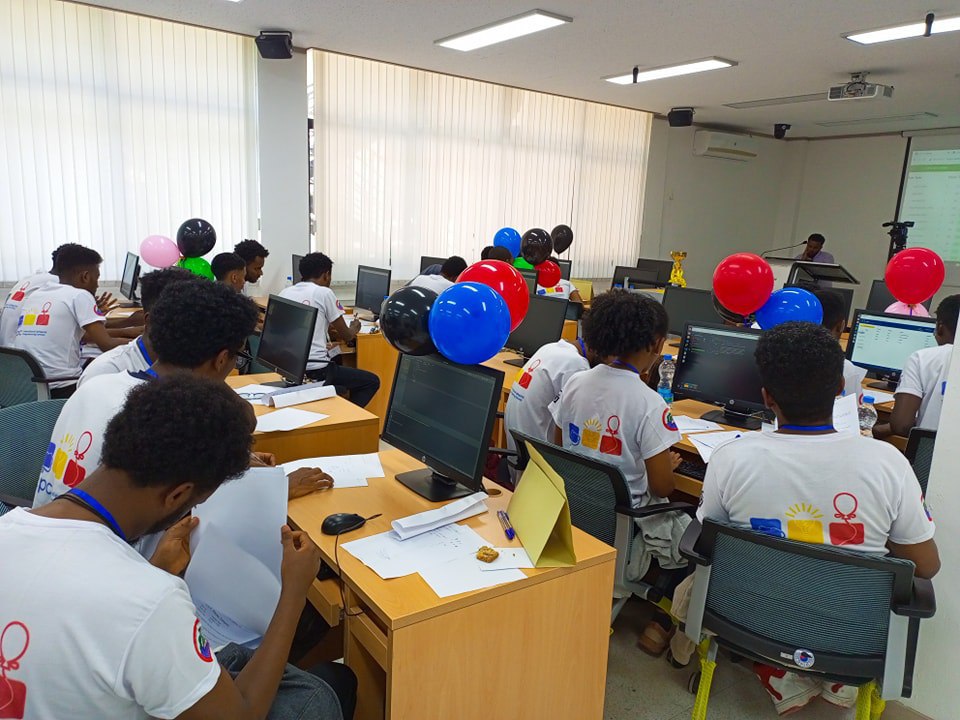
Besides a Laptop for each academic staff, there are four well-furnished and internet connected computer labs with a capacity of 30 each.
Career Pathways
Mathematics graduates have a wide range of career pathways to choose from, each offering unique opportunities and challenges. Here are some of the common career paths in mathematics:
Actuary: Utilizing probability and statistics, actuaries assess risks in various industries, including insurance and finance.
Financial Analyst: Financial analysts interpret economic data to guide investment decisions and analyse market trends.
Data Scientist: Data scientists use statistical methods and programming languages to analyse data and uncover insights.
Statistician: Statisticians apply mathematical principles to collect, analyze, and interpret data for decision-making.
Mathematician: Mathematicians solve complex problems across various fields, including physics, engineering, and computer science. These roles require a strong foundation in mathematics, along with additional skills such as programming, data analysis, and communication. The demand for mathematics graduates is high, with opportunities in finance, technology, healthcare, and academia. Continuous learning and professional development are essential for success in these fields
Mentors: Mathematics graduates can be mentors at high schools, universities and other education sectors
Upcoming Events
Calendar
| November 2026 | ||||||
|---|---|---|---|---|---|---|
| M | T | W | T | F | S | S |
| 1 | ||||||
| 2 | 3 | 4 | 5 | 6 | 7 | 8 |
| 9 | 10 | 11 | 12 | 13 | 14 | 15 |
| 16 | 17 | 18 | 19 | 20 | 21 | 22 |
| 23 | 24 | 25 | 26 | 27 | 28 | 29 |
| 30 | ||||||
Systems

Connect with us
We're on Social Networks.
Follow us & get in touch.